
Ultra-Zone Guidance
1. What is an HVAC zoning system?
An HVAC zoning system divides a home or building into separate areas, or “zones,” that can be independently controlled by individual thermostats. Instead of heating or cooling the entire building based on the temperature at one thermostat, zoning directs conditioned air only where it is needed.
A typical forced-air zoning system consists of a zone control panel, thermostats, motorized zone dampers and a dedicated transformer. Depending on the HVAC system and duct design, a static pressure control or bypass solution may also be required.
The zone control panel acts as the brain of the system. It monitors thermostat calls, positions the appropriate dampers and communicates with the heating and cooling equipment.
Related EWC Resources:
How EWC Ultra-Zone Works
Zone Control Panels
2. How does HVAC zoning work?
HVAC zoning uses multiple thermostats and motorized dampers to independently control temperatures in different areas of a building.
Each thermostat communicates with a central zone control panel. When a zone requires heating or cooling, the panel opens the damper serving that zone and operates the HVAC equipment as required. Dampers serving zones that do not require conditioning can remain closed.
As additional zones call or become satisfied, the control panel continually manages the dampers and HVAC equipment. More advanced zoning systems can also manage equipment staging, heat pump operation, dual-fuel systems, supply-air temperature and other equipment functions.
Related EWC Resources:
How EWC Ultra-Zone Works
EWC Zone Control Panels
3. Can HVAC zoning be added to an existing home?
Yes. HVAC zoning can often be added to an existing forced-air heating and cooling system, making zoning a popular retrofit option.
A typical retrofit installation adds motorized dampers to the existing duct system, installs thermostats in each desired zone and connects those components to a zone control panel. The existing furnace, air handler or heat pump may be able to remain in place.
However, every system should be evaluated before adding zoning. Equipment airflow requirements, available duct capacity, zone size and static pressure all need to be considered. In some applications, a bypass damper or another static pressure control strategy may be required.
EWC Controls zoning systems are designed for both retrofit and new-construction applications.
Related EWC Resources:
Zone Control Panels
EWC Dampers
4. What is an HVAC zone damper?
An HVAC zone damper is a motorized damper installed inside the ductwork that controls airflow to an individual zone.
The damper receives commands from the zone control panel to open or close based on thermostat demand. When a zone calls for heating or cooling, its damper opens to allow conditioned air into that area. Dampers serving non-calling zones can close to redirect airflow toward the zones that need conditioning.
Zone dampers are available in different shapes, sizes and actuator configurations to accommodate different duct systems and control applications.
EWC Controls manufactures both round and rectangular motorized dampers for residential and light commercial forced-air zoning systems.
Related EWC Resources:
EWC Damper Products
URD Damper Technical Resources
ND Damper Technical Resources
5. What is the difference between a round and rectangular zone damper?
The primary difference is the type of ductwork in which the damper is installed.
Round zone dampers, such as the EWC Controls URD, are designed for round duct applications. Rectangular dampers, such as the EWC Controls ND, are designed for rectangular ductwork.
Both perform the same basic zoning function: controlling airflow to an individual zone in response to commands from the zone control panel.
The correct damper should be selected based on the duct dimensions, required airflow and application. Multiple dampers can also be controlled from a single zone when the system design requires more than one duct serving the same area.
Related EWC Resources:
URD Damper Technical Resources
ND Damper Technical Resources
All Manuals & Technical Bulletins
6. Why does static pressure increase when HVAC zones close?
When zone dampers close, the HVAC system is attempting to move air through less available ductwork. If the equipment continues producing the same airflow while the available duct area decreases, system static pressure can increase.
Excessive static pressure can contribute to airflow noise, reduced equipment performance and other operational problems. For this reason, static pressure should be considered when designing any forced-air zoning system.
Depending on the application, excess airflow can be managed through equipment airflow control, proper duct and zone sizing, a bypass damper or another static pressure control strategy.
EWC Controls offers several static pressure management solutions, including Smart Bypass Dampers and the Distributed Air Pressure Controller (DAPC).
Related EWC Resources:
Smart Bypass Dampers
DAPC – Distributed Air Pressure Controller
Bypass Damper Products
7. Does every HVAC zoning system need a bypass damper?
No. Not every HVAC zoning system requires a bypass damper.
Whether a bypass is needed depends on the HVAC equipment, duct design, airflow requirements, zone sizes and the system’s ability to manage airflow as zones open and close.
Modern variable-speed and variable-capacity equipment may be capable of reducing airflow as zoning demand decreases. Other systems may require an additional method of controlling static pressure.
When a traditional bypass duct is undesirable or cannot be installed, other strategies may also be available. EWC Controls’ DAPC, for example, monitors system static pressure and can modulate selected non-calling zone dampers to relieve excessive pressure without using a conventional bypass duct.
Static pressure and airflow should always be evaluated as part of the overall zoning system design.
Related EWC Resources:
DAPC – Distributed Air Pressure Controller
Smart Bypass Dampers
Bypass Damper Products
8. What is a bypass damper and how does it work?
A bypass damper provides a path for excess supply air when zone dampers close and system static pressure increases.
The bypass duct typically connects the supply side of the HVAC system to the return side. As system pressure increases, the bypass damper opens or modulates to relieve excess pressure. As additional zones open and available duct capacity increases, the bypass damper closes or reduces the amount of bypass airflow.
There are several types of bypass control. Traditional barometric bypass dampers use pressure and mechanical adjustment, while electronic and smart bypass dampers actively monitor system pressure.
EWC Controls’ SBD Smart Bypass Damper automatically measures system static pressure during setup and modulates during zoning operation to maintain the learned operating static pressure.
Related EWC Resources:
SBD Smart Bypass Damper
SBD Technical Submittal
EWC Bypass Damper Products
9. What is the difference between a barometric and electronic bypass damper?
A barometric bypass damper operates mechanically. As static pressure increases, pressure acting against the damper blade overcomes an adjustable counterweight and allows the damper to open. The EWC Controls PRD is an example of a barometric pressure-regulating bypass damper.
An electronic bypass uses a motor and pressure control to actively position the damper. Electronic control provides more precise management of system static pressure and does not depend solely on mechanical weights.
EWC also offers the SBD Smart Bypass Damper, which automatically measures the HVAC system’s operating static pressure during setup and then modulates the bypass damper to maintain that pressure as zones open and close.
The appropriate bypass method depends on system design, equipment requirements, available space and desired level of pressure control.
Related EWC Resources:
EWC Bypass Dampers
SBD Smart Bypass Damper
SBD Technical Submittal
10. What is the difference between the EWC SBD and DAPC?
The EWC Controls SBD and DAPC both help manage static pressure in zoned HVAC systems, but they accomplish it differently.
The SBD Smart Bypass Damper is installed in a bypass duct. During setup, it measures the HVAC system’s operating static pressure. During zoning operation, the SBD modulates the bypass damper as needed to maintain that pressure as zone dampers open and close.
The DAPC Distributed Air Pressure Controller provides a bypass-free approach. It monitors system static pressure and the zone damper commands coming from an EWC Controls zone panel. When pressure becomes too high, the DAPC can modulate selected non-calling zone dampers and distribute excess airflow through the duct system.
The DAPC can be particularly useful when there is insufficient space for a bypass duct or when a bypass damper is not desirable for the application.
Related EWC Resources:
DAPC Product Information & Technical Bulletin
SBD Smart Bypass Damper
SBD Technical Submittal
11. What does an HVAC zone control panel do?
The zone control panel is the central controller, or “brain,” of a forced-air zoning system.
The panel receives heating and cooling calls from the thermostats serving each zone. It then controls the appropriate zone dampers and communicates the required heating, cooling and fan commands to the HVAC equipment.
Depending on the panel and equipment, the zone controller may also manage functions such as equipment staging, heat pump operation, dual-fuel changeover, supply-air temperature protection and opposite-mode calls.
Selecting the correct zone control panel depends on the HVAC equipment type, number of zones and level of control required.
Related EWC Resources:
EWC Zone Control Panels
Manuals & Technical Bulletins
12. How do I choose the correct EWC zone control panel?
The correct zone control panel depends primarily on the type of HVAC equipment, number of zones and control features required.
For simpler conventional applications, a basic zone control panel may provide everything required. Systems using multi-stage equipment, heat pumps, dual-fuel configurations or larger numbers of zones may require a more advanced or expandable control.
For example, the EWC Controls BMPlus-3z supports conventional, multi-stage, heat pump and dual-fuel applications and can expand from three zones up to nine zones using XM-3z expansion panels.
Before selecting a panel, identify the equipment type and stages, number of zones, thermostat requirements, damper configuration and any special control requirements.
Related EWC Resources:
BMPlus-3z Product Information
EWC Zone Control Panels
Manuals & Technical Bulletins
13. Can an EWC zone control panel control a heat pump?
Yes. EWC Controls offers zone control panels designed to operate heat pump systems.
A heat pump zoning application requires the zone control panel to coordinate thermostat calls, zone dampers, compressor operation, reversing valve operation and auxiliary or supplemental heat when applicable.
The specific panel should be selected based on the heat pump configuration, number of equipment stages, number of zones and whether additional functions such as dual-fuel control are required.
For example, the BMPlus-3z is compatible with heat pump applications as well as conventional, multi-stage and dual-fuel equipment.
Always verify the equipment configuration and wiring requirements in the applicable EWC installation manual before installation.
Related EWC Resources:
BMPlus-3z Product Information
EWC Manuals & Technical Bulletins
14. Can an EWC zone control panel control a dual-fuel system?
Yes. Select EWC Controls zone panels can control dual-fuel HVAC applications.
A dual-fuel system typically combines a heat pump with a fossil-fuel heating source, such as a gas furnace. The zoning system must coordinate zone demand while also determining when the heat pump or fossil-fuel heating equipment should operate.
Depending on the panel and system configuration, changeover can be managed based on outdoor temperature, equipment demand and programmed control settings.
The BMPlus-3z is designed for conventional, heat pump and dual-fuel applications. Because dual-fuel configurations can vary significantly by equipment manufacturer, installers should verify the specific application and wiring requirements before installation.
Related EWC Resources:
BMPlus-3z Product Information
EWC Manuals, Wiring Diagrams & Technical Bulletins
15. Why isn’t my HVAC zone damper opening or closing?
A zone damper that does not open or close can be caused by the damper actuator, wiring, thermostat, zone control panel or the damper itself.
Start by determining whether the zone control panel is sending the proper open or close command to the damper. Verify that the correct voltage is present at the appropriate damper terminals and inspect the thermostat and zone panel indicators to confirm the zone’s current status.
If the proper command is reaching the damper but the actuator does not move, inspect the actuator and damper blade for mechanical problems. If no command is present, troubleshooting should move upstream to the zone panel, thermostat and associated wiring.
EWC provides wiring diagrams and application notes for URD and ND dampers, including multiple-damper installations and other special applications.
Related EWC Resources:
URD Damper Technical Resources
ND Damper Technical Resources
Manuals & Technical Bulletins
16. What is the difference between a 2-wire and 3-wire zone damper?
The primary difference is how the damper actuator is powered and controlled.
A 3-wire power-open/power-close damper uses separate electrical signals to drive the damper open and closed. EWC Controls ND, URD and SID dampers with the standard MA-ND5 actuator use this type of operation.
A 2-wire spring-return damper is powered in one direction and uses an internal spring to return the damper to its normal position when power is removed.
Damper type is important when selecting a zone control panel and determining how many dampers can be connected to a zone. Always verify the actuator’s voltage, operating method and current requirements before connecting it to a zone control panel.
Related EWC Resources:
URD Damper Technical Resources
ND Damper Technical Resources
Damper Wiring & Technical Bulletins
17. How do I determine what size HVAC zone damper I need?
A zone damper is generally sized to match the duct in which it will be installed.
For round ductwork, select a round damper that matches the duct diameter. For rectangular ductwork, the damper dimensions should match the duct dimensions.
However, selecting the correct damper is only one part of proper zoning design. The duct and damper must also be capable of delivering the airflow required by the zone.
If a zone requires more airflow than the existing duct can provide, installing a larger damper alone will not solve the airflow problem. Duct sizing, available static pressure, equipment airflow and the required CFM for each zone should all be considered.
Related EWC Resources:
EWC Dampers
URD Round Damper Resources
ND Rectangular Damper Resources
18. Can multiple zone dampers be connected to one HVAC zone?
Yes. Multiple dampers can be controlled by a single zone when multiple ducts serve the same conditioned area.
The dampers are typically wired in parallel so they open and close together when the zone thermostat calls or becomes satisfied.
The number of dampers that can be connected directly to a zone output depends on the zone panel and the electrical requirements of the damper actuators. Exceeding the panel’s allowable output can overload the damper circuit.
EWC Controls publishes wiring diagrams showing how multiple ND and URD dampers can be connected to a single zone. For applications requiring additional dampers, an isolation relay and separate transformer may be required.
Related EWC Resources:
ND/URD Multiple Damper Wiring Diagrams
URD Technical Resources
ND Technical Resources
19. How do I test an HVAC zone damper motor?
Start by determining whether the zone control panel is providing the proper 24VAC command to the damper.
For a 3-wire power-open/power-close damper, verify voltage between the common terminal and the appropriate open or close terminal. The damper should travel in the commanded direction when the proper voltage is applied.
EWC Controls MA-ND5 actuators used on many ND and URD dampers also provide visual position indication, which can help during troubleshooting.
If the correct voltage is present but the actuator does not move, inspect the actuator, wiring and damper blade for mechanical problems. If voltage is not present, troubleshooting should move upstream to the zone control panel and associated wiring.
Related EWC Resources:
URD Technical Resources
ND Technical Resources
Damper Wiring Diagrams
20. Can I replace another manufacturer’s zone damper with an EWC Controls damper?
In many applications, yes, provided the replacement damper is mechanically and electrically compatible with the existing zoning system.
Important considerations include duct size, damper dimensions, actuator voltage, wiring configuration and whether the existing zone panel is designed for power-open/power-close or spring-return dampers.
EWC Controls manufactures round and rectangular dampers in a wide range of sizes and actuator configurations, making them suitable for many replacement and retrofit applications.
Before replacing a damper from another manufacturer, verify the existing control panel’s damper output and wiring requirements.
Related EWC Resources:
EWC Damper Products
URD Technical Resources
ND Technical Resources
Bypass Dampers & Static Pressure
21. What static pressure should a zoned HVAC system operate at?
There is no single static pressure setting that is correct for every HVAC system.
Acceptable static pressure depends on the furnace or air handler, blower configuration, evaporator coil, filter, duct system and manufacturer’s allowable external static pressure.
The goal of a properly designed zoning system is to maintain adequate airflow through the equipment while preventing excessive static pressure as individual zones close.
Static pressure should be measured and compared with the HVAC equipment manufacturer’s airflow and external static pressure specifications.
EWC Controls offers several methods of managing static pressure, including barometric, electronic and smart bypass dampers as well as the DAPC Distributed Air Pressure Controller.
Related EWC Resources:
EWC Bypass Dampers
SBD Smart Bypass Damper
DAPC Technical Documentation
22. Can you install HVAC zoning without a bypass damper?
Yes. Some properly designed zoning systems can operate without a traditional bypass damper.
The HVAC equipment may be capable of reducing airflow as zones close, or the duct system and zone sizes may provide enough available airflow that excessive static pressure does not occur.
Another option is active pressure management. The EWC Controls DAPC monitors system static pressure and can modulate selected non-calling EWC zone dampers to relieve excess pressure without using a conventional supply-to-return bypass duct.
Whether a bypass is required should be determined by evaluating equipment airflow requirements, duct design, individual zone sizes and measured system static pressure.
Related EWC Resources:
DAPC Technical Documentation
EWC Bypass Dampers
23. Do variable-speed HVAC systems need bypass dampers?
Not necessarily.
Variable-speed and variable-capacity HVAC equipment can often reduce airflow as heating or cooling demand decreases. This can make the equipment better suited for zoning than equipment that maintains a fixed airflow.
However, a variable-speed blower does not automatically eliminate all zoning airflow concerns. The equipment’s minimum airflow, smallest zone size, duct design and manufacturer’s operating requirements still need to be considered.
Static pressure should be measured under worst-case zoning conditions—typically when the smallest zone or minimum amount of ductwork is open.
If excessive static pressure occurs, additional airflow management may still be necessary.
Related EWC Resources:
EWC Bypass Dampers
DAPC Technical Documentation
SBD Smart Bypass Damper
24. What happens if static pressure gets too high in a zoned HVAC system?
Excessive static pressure can reduce airflow, increase air velocity and create objectionable duct or register noise.
More importantly, inadequate airflow across the HVAC equipment can contribute to operational problems. Furnaces may reach high-temperature limits, while cooling systems may experience low coil temperatures or other airflow-related problems.
High static pressure can also place additional load on the blower and negatively affect overall system performance.
Proper zoning design therefore requires consideration of the HVAC equipment’s airflow requirements and the amount of ductwork available when individual zones close.
Solutions can include proper duct sizing, equipment airflow adjustment, bypass dampers or active static pressure management.
Related EWC Resources:
EWC Bypass Dampers
DAPC Technical Documentation
SBD Smart Bypass Damper
25. How do I size a bypass damper?
A bypass damper should be sized for the amount of excess airflow that may need to be relieved when zones close.
This is not necessarily the total airflow of the HVAC system. The required bypass capacity depends on how much airflow can safely pass through the calling zones and how much additional airflow must be managed.
For example, if the equipment is moving 1,200 CFM but the calling zones can safely accept 800 CFM, approximately 400 CFM may need to be managed through a bypass or another airflow-control method.
Proper sizing should consider equipment airflow, zone duct capacity, system static pressure and the operating characteristics of the selected bypass damper.
Related EWC Resources:
EWC Bypass Damper Products & Sizing Information
SBD Smart Bypass Damper
Zone Control Panels
26. What is the difference between the EWC NCM-3z and BMPlus-3z?
Both the NCM-3z and BMPlus-3z are three-zone control panels, but they are designed for different levels of HVAC system control.
The appropriate panel depends on equipment type, staging requirements and the overall zoning application.
The BMPlus-3z provides advanced equipment-control capabilities for applications including multi-stage conventional equipment, heat pumps and dual-fuel systems. It can also be expanded beyond three zones using XM-3z expansion panels.
The NCM-3z provides a streamlined solution for applications that do not require the additional staging and equipment-management capabilities of the BMPlus platform.
Always match the zone panel to the specific HVAC equipment and application rather than selecting a panel based only on the number of zones.
Related EWC Resources:
BMPlus-3z Technical Documentation
NCM-3z Technical Documentation
EWC Zone Control Panels
27. Can a zone control panel operate multi-stage heating and cooling equipment?
Yes. Select EWC Controls zone panels are designed to operate multi-stage HVAC equipment.
In a zoned system, staging can be based on factors such as the number of zones calling, thermostat demand, time and other panel-specific control logic.
Proper staging is particularly important in zoning because equipment capacity should ideally match the amount of conditioned space currently requiring heating or cooling.
Using lower equipment capacity when fewer zones are calling can help reduce excessive airflow and improve comfort.
The exact staging method depends on the EWC panel being used and its configuration.
Related EWC Resources:
BMPlus-3z Technical Documentation
EWC Zone Control Panels
28. How does an HVAC zone control panel control equipment staging?
A zone control panel can determine when additional heating or cooling stages should operate based on the panel’s control strategy and configuration.
Depending on the control, staging may be influenced by the number of zones calling, elapsed time, thermostat staging commands or other system conditions.
This is especially useful in zoned systems because the amount of available ductwork changes as dampers open and close. Operating lower equipment capacity when fewer zones are calling can better match equipment output to the current load.
More advanced EWC zone controls provide configurable staging options so the installer can match zoning operation to the HVAC equipment and application.
Related EWC Resources:
BMPlus-3z Manual
EWC Zone Control Panels
29. Can I use standard 24-volt thermostats with an EWC Controls zone panel?
Many EWC Controls zoning systems are designed to operate with conventional 24VAC thermostats.
Thermostat compatibility depends on the specific zone control panel and HVAC equipment configuration. Conventional single-stage, multi-stage and heat pump applications may require different thermostat terminals and setup.
Some communicating HVAC systems require specialized controls or interfaces rather than standard 24VAC thermostats.
Always review the thermostat requirements shown in the installation manual for the specific EWC zone panel before selecting or wiring thermostats.
Related EWC Resources:
EWC Zone Control Panel Manuals
EWC Zone Control Panels
30. How many zones can an EWC Controls zone panel control?
The number of zones depends on the EWC control panel.
Some panels are designed as dedicated three-zone controls, while others can be expanded to accommodate larger zoning systems.
For example, the BMPlus-3z starts as a three-zone control and can be expanded using XM-3z expansion panels for systems requiring additional zones.
When designing larger zoning systems, installers should consider not only the number of thermostats but also damper quantity, transformer capacity, equipment staging and airflow requirements.
Related EWC Resources:
BMPlus-3z Documentation
XM-3z Expansion Panel Documentation
EWC Zone Control Panels
31. Can I replace an existing zone control panel with an EWC Controls panel?
In many applications, yes.
When replacing a zone control panel, the new panel must be compatible with the HVAC equipment, thermostats and zone dampers already installed.
Important considerations include equipment type, number of heating and cooling stages, heat pump or conventional operation, dual-fuel requirements, damper wiring and thermostat configuration.
Existing field wiring can often be reused when it is compatible and in good condition, making a control-panel replacement significantly easier than replacing the entire zoning system.
Before selecting a replacement, document the existing equipment, thermostat terminals, damper type and wiring.
Related EWC Resources:
EWC Zone Control Panels
EWC Manuals & Wiring Diagrams
Troubleshooting HVAC Zoning
32. Why isn’t one of my HVAC zones getting airflow?
First determine whether the zone thermostat is calling and whether the zone control panel recognizes the call.
If the panel recognizes the zone but airflow is not reaching the space, check whether the associated zone damper has opened. Verify damper wiring and confirm the actuator receives the proper command from the zone panel.
If the damper is fully open but airflow remains low, the problem may be related to duct restrictions, balancing dampers, closed registers, inadequate duct sizing or system airflow.
Troubleshooting the system in order—thermostat, zone panel, damper and then airflow—can help isolate the problem quickly.
Related EWC Resources:
URD Technical Resources
ND Technical Resources
EWC Technical Documentation
33. Why does my HVAC system keep running after a zone is satisfied?
A zoned HVAC system may continue operating briefly after a thermostat becomes satisfied because of built-in purge, staging or equipment-protection functions.
During a purge cycle, the HVAC equipment or blower may continue operating to move remaining conditioned air out of the equipment and duct system.
Another zone may also still be calling even though the thermostat being observed is satisfied.
If the equipment continues running beyond the expected control sequence, check the zone panel LEDs or diagnostic indicators to determine whether another thermostat call or equipment output remains active.
Related EWC Resources:
EWC Zone Control Panel Manuals
EWC Zone Control Panels
34. Why are all of my zone dampers open?
Many zoning systems are designed to drive all zone dampers open when the HVAC equipment is idle and no thermostats are calling.
This reduces restriction in the duct system during idle periods and leaves the system in a known position for the next call.
When a thermostat calls, the zone control panel should position the dampers according to the zones requiring conditioning.
If all dampers remain open while the HVAC equipment is actively responding to only one zone, verify the thermostat calls, zone-panel indicators and damper outputs.
Related EWC Resources:
ND/URD Damper Wiring Diagrams
URD Technical Resources
ND Technical Resources
35. Why is my HVAC system noisy when only one zone is calling?
Excessive airflow velocity or static pressure is a common cause of noise when only one HVAC zone is calling.
As non-calling zone dampers close, the same or similar amount of blower airflow may be forced through a smaller amount of ductwork. This can increase air velocity and create noise at dampers, ducts and supply registers.
The system should be evaluated for equipment airflow, duct sizing and static pressure under minimum-zone conditions.
Possible solutions include reducing equipment airflow when appropriate, increasing available duct capacity or using a bypass or active pressure-management strategy.
Related EWC Resources:
DAPC Technical Documentation
SBD Smart Bypass Damper
EWC Bypass Dampers
36. Why is my furnace going off on high-temperature limit with zoning?
A furnace may reach its high-temperature limit if there is insufficient airflow across the heat exchanger.
In a zoned system, this can occur when too many dampers close and the remaining open zones cannot accept the airflow required by the furnace.
Other causes can include a dirty filter, restricted ductwork, incorrect blower settings or an oversized furnace.
Check total external static pressure and temperature rise and compare them with the furnace manufacturer’s specifications. The zoning system should provide enough airflow under all operating conditions to keep the furnace within its approved temperature-rise range.
Related EWC Resources:
EWC Bypass Dampers
DAPC Technical Documentation
SBD Smart Bypass Damper
37. Why does my bypass damper stay open?
A bypass damper that remains open may indicate excessive static pressure, improper adjustment, incorrect installation or a mechanical/control problem.
First verify that the zone dampers are operating correctly and that the system airflow is appropriate. If too many zone dampers are closed relative to the blower airflow, the bypass may simply be responding to high static pressure as intended.
For adjustable bypass dampers, verify the pressure setting and installation according to the manufacturer’s instructions.
Electronic and smart bypass dampers should also be checked for proper power, pressure tubing and sensor installation.
Related EWC Resources:
SBD Smart Bypass Damper
EWC Bypass Dampers
EWC Technical Documentation
38. Why is there too much airflow in one HVAC zone?
Too much airflow in a zone can result from duct sizing, system balancing, blower airflow or the number of other zones that are closed.
When only one or two zones call, a larger percentage of the HVAC system’s total airflow may be directed into those zones. If the equipment cannot reduce airflow sufficiently, the calling zone may receive more air than its ductwork or registers were designed to handle.
The solution may involve system balancing, airflow adjustment, equipment staging or static-pressure management.
A properly designed zoning system should consider both maximum-demand operation and minimum-zone operation.
Related EWC Resources:
DAPC Technical Documentation
EWC Bypass Dampers
39. How can I tell if the problem is my thermostat, zone panel or zone damper?
Troubleshoot the system in sequence.
First determine whether the thermostat is generating the correct heating or cooling call. Next, verify that the corresponding zone LED or diagnostic indicator on the zone control panel recognizes that call.
If the panel recognizes the thermostat demand, check whether it is sending the correct command to the zone damper and HVAC equipment.
If the proper voltage reaches the damper but the damper does not move, the problem is likely associated with the actuator, damper or field wiring.
Following the control signal from thermostat → zone panel → damper/equipment is usually the fastest way to isolate a zoning problem.
Related EWC Resources:
EWC Zone Control Panel Manuals
URD Technical Resources
ND Technical Resources
40. What should I check first when troubleshooting an HVAC zoning system?
Start with the basics before replacing components.
Verify that the zone panel has proper power and inspect its LEDs or diagnostic indicators. Determine which thermostats are calling and confirm that the panel recognizes those calls.
Next, check whether the HVAC equipment and zone dampers are responding to the panel’s outputs.
If a damper is not responding, verify the 24VAC signal and field wiring before assuming the actuator has failed.
Also inspect the air filter, registers and duct system if the problem involves airflow rather than control operation.
Related EWC Resources:
EWC Manuals & Technical Bulletins
URD Technical Resources
ND Technical Resources
Advanced HVAC Zoning
41. Can you zone a variable-speed HVAC system?
Yes. Variable-speed HVAC systems can be excellent candidates for zoning when the equipment and zoning controls are properly applied.
As zones become satisfied and dampers close, a variable-speed blower may be able to reduce airflow to better match the available ductwork.
However, variable-speed does not mean airflow can be reduced without limit. Every furnace, air handler and heat pump has minimum operating airflow requirements.
The zoning design must still consider the smallest zone, equipment capacity, duct sizing and static pressure.
Related EWC Resources:
EWC Zone Control Panels
DAPC Technical Documentation
42. Can you zone an inverter heat pump?
Yes, but the zoning solution must be compatible with the inverter equipment’s control architecture and airflow requirements.
Inverter systems can vary compressor capacity and often blower airflow to match building demand. This can provide significant advantages in a zoned application because equipment capacity can potentially decrease as fewer zones require conditioning.
Some inverter systems use conventional 24VAC controls while others use proprietary communicating controls.
Before selecting a zoning system, determine how the equipment communicates and whether the manufacturer permits third-party zoning controls.
EWC Controls offers solutions for both conventional HVAC applications and select communicating equipment.
Related EWC Resources:
EWC Zone Control Panels
UT-3000 Technical Documentation
43. Can you zone a communicating HVAC system?
Yes, but communicating HVAC equipment requires a zoning control designed specifically to communicate with that equipment or an approved method of interfacing conventional zoning controls.
Unlike conventional systems that rely primarily on individual 24VAC heating and cooling signals, communicating systems exchange digital information between thermostats, indoor equipment and outdoor equipment.
Because communication protocols can be proprietary, a conventional zone panel should not automatically be assumed compatible.
Always verify compatibility with both the zoning-control manufacturer and HVAC equipment requirements.
Related EWC Resources:
UT-3000 Technical Documentation
EWC Zone Control Panels
44. How small can an HVAC zone be?
There is no universal minimum square footage for an HVAC zone.
The more important consideration is whether the zone’s ductwork can handle the minimum airflow and capacity produced by the HVAC equipment.
A small bedroom, for example, may require only a fraction of the airflow produced by the system. If that room becomes the only calling zone, excessive static pressure, airflow noise or equipment operating problems can result.
Before creating a small zone, determine its design airflow and compare that with the HVAC system’s minimum operating airflow.
Small zones may require additional airflow-management strategies or different zoning design.
Related EWC Resources:
DAPC Technical Documentation
EWC Bypass Dampers
45. Can one bedroom be its own HVAC zone?
Yes, but the HVAC system and ductwork must be capable of operating properly when that bedroom is the only zone calling.
A single bedroom may have a relatively small heating or cooling load and limited duct capacity. If the HVAC equipment produces substantially more airflow than the room can accept, static pressure and airflow velocity can increase significantly.
Before creating a very small zone, evaluate the room’s required CFM, duct capacity and the HVAC equipment’s minimum airflow.
A bypass damper, active static-pressure control or zoning strategy that maintains additional airflow may be necessary.
Related EWC Resources:
DAPC Technical Documentation
EWC Bypass Dampers
46. Should zone dampers be installed in the supply or return duct?
Zone dampers are typically installed in the supply ductwork serving each individual zone.
By controlling the supply air delivered to each area, the zoning system can independently regulate temperature based on each zone thermostat.
Return-air design is still extremely important. Return paths should allow adequate airflow back to the HVAC equipment regardless of which zones are calling.
Restricting return airflow can create equipment and comfort problems, so return-air design should be evaluated as part of the complete zoning system.
Related EWC Resources:
EWC Damper Products
URD Technical Resources
ND Technical Resources
47. Where should an HVAC zone damper be installed?
Whenever practical, a zone damper should be installed where it can effectively control the entire duct serving the zone while remaining accessible for service.
For many applications, this means installing the damper near the branch takeoff from the main supply trunk rather than near an individual supply register.
Installing the damper upstream allows one damper to control all downstream branches serving that zone.
Always follow the damper manufacturer’s installation requirements regarding orientation, distance from the heating source, accessibility, insulation and mechanical support.
Related EWC Resources:
URD Technical Resources
ND Technical Resources
EWC Damper Products
48. What is the difference between EWC URD, ND and SID zone dampers?
The URD, ND and SID are motorized zone dampers designed for different duct applications.
The URD is EWC Controls’ round zone damper and is designed for round ductwork.
The ND is a rectangular zone damper designed for rectangular duct systems.
The SID is designed for side-insertion applications where installing a traditional framed rectangular damper may be difficult or impractical.
All three can be used as part of an EWC forced-air zoning system when properly selected for the duct and application.
Related EWC Resources:
URD Technical Resources
ND Technical Resources
SID Technical Documentation
49. Can EWC Controls dampers work with another manufacturer’s zone control panel?
In many cases, yes.
Zone damper compatibility is primarily determined by actuator voltage, control method and the electrical capacity of the zone panel’s damper outputs.
EWC Controls ND, URD and SID dampers are available with common 24VAC actuator configurations used in forced-air zoning systems.
Before connecting an EWC damper to another manufacturer’s panel, verify whether the panel is designed for power-open/power-close or spring-return dampers and confirm the allowable current on each zone output.
The damper and control-panel wiring diagrams should always be reviewed before installation.
Related EWC Resources:
URD Technical Resources
ND Technical Resources
EWC Damper Wiring Diagrams
50. How many dampers can be connected to one HVAC zone?
The number of dampers that can be connected to a single zone depends on the zone control panel’s damper-output capacity and the current draw of the damper actuators.
EWC’s low-current power-open/power-close dampers can allow multiple dampers to operate from a single zone output in many applications. For example, EWC documentation for the UT-3000 permits up to three ND, URD or SID dampers on a single zone terminal block.
That number should not automatically be applied to every EWC control panel. Always verify the specific zone panel’s output rating and damper wiring instructions.
When the required damper load exceeds the panel’s output capacity, an isolation relay and separate transformer can be used to control additional dampers.
Related EWC Resources:
ND/URD Multiple Damper Wiring Diagrams
URD Technical Resources
ND Technical Resources
UT-3000 Technical Documentation
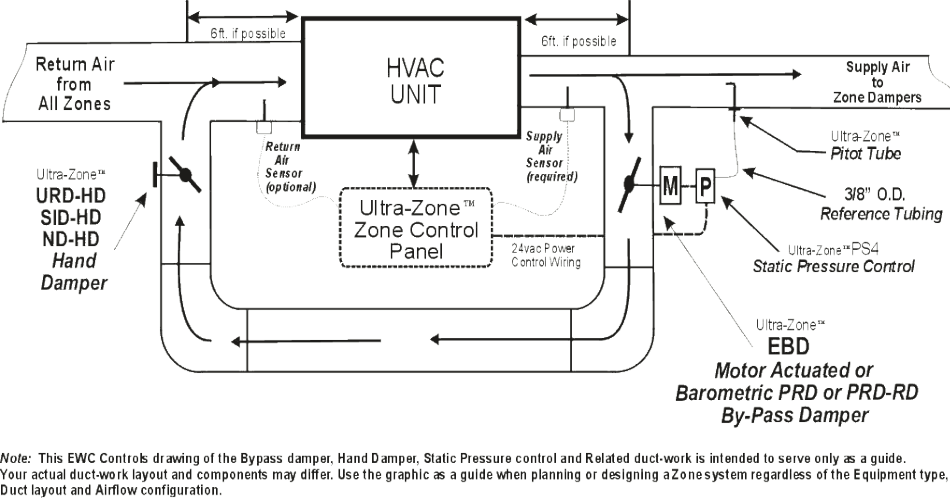
When tapping back into the return duct, the tap is recommended to be at least 6 feet away from the equipment if you have the room and clearance. This is done to ensure that the hot or cold air coming off the plenum has ample time to mix with the return air before going across the coil again. In addition, a Balancing or Restricting Hand Damper should be installed in the bypass duct. It’s the perfect way to ensure sufficient restriction of bypass air-flow and proper mixing of Bypass air with Return air.
Supply Air Temperature Sensors are mandatory when you install an Air Zone system. The sensor will protect the HVAC equipment heat exchanger from overheating and the DX coil from freeze-up conditions. EWC Controls includes the Supply Air Sensor (Part# SAS) with every micro-processor based Ultra-Zone control panel.
If the bypass method is used either exclusively or along with other tools, the bypass duct should be sized to manage the airflow and volume under the worst case scenario, which means the smallest Cfm zone may be the only zone calling at any given time. That scenario will cause the most volume build-up. The calculation is done by taking the total Cfm capacity of the smallest zone and subtracting that number from the total Cfm delivered by the HVAC system. If you have airflow from Damper Leakage and Open Runs, subtract that also.
In Conclusion,
As stated previously, there are several tools you may use to manage excess air volume. EWC Controls recommends using at least two or more of these tools in order to effectively manage airflow and volume on any Air Zoned system. Use the Bypass Graphic as a guide when designing your systems. Doing so will save you valuable time and labor. Contact EWC Controls for Technical Support if you have any questions or concerns. EWC Controls will help you make all of your zoning installations Excellent Without Compromise.